GEO vs SEO: Why Your Agency Needs to Master Both to Stay Competitive
 Barcodes Pro,
2025-11-30
8 min read
Barcodes Pro,
2025-11-30
8 min read
Introduction: The Changing Search Landscape in 2025
In 2025, the digital marketing world is witnessing a historic transformation. Search isn’t just about ranking on Google anymore it’s about appearing in AI-driven conversations. Users now ask complex questions to tools like ChatGPT, Google Gemini, Bing Copilot, and Perplexity, and expect summarized, credible answers instantly.
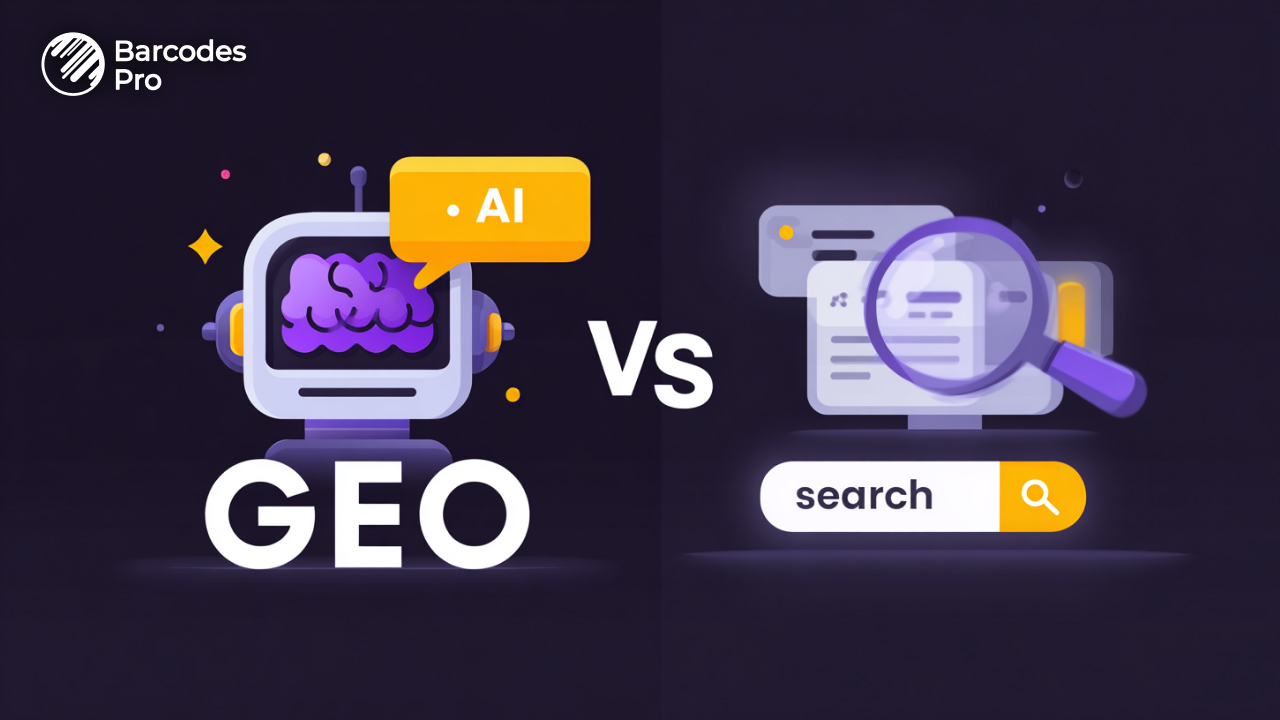
This shift has given rise to a new discipline, Generative Engine Optimization (GEO) the practice of optimizing content for AI-generated responses. But does this mean Search Engine Optimization (SEO) is dead? Not at all. Instead, we are entering an era of GEO vs SEO where both strategies must coexist and complement each other to ensure your agency’s survival and growth.
In this article, we’ll explore the differences between GEO and SEO, how they intersect, and why agencies that master both will dominate in the AI-driven marketing ecosystem.
Understanding SEO: The Backbone of Online Visibility
Before diving into Generative Engine Optimization, it’s crucial to revisit the fundamentals of SEO, the foundation on which online visibility has been built for decades.
What Is SEO?
Search Engine Optimization (SEO) is the process of improving a website’s visibility on traditional search engines like Google and Bing. The goal is simple: appear as high as possible in search results for specific queries that match your audience’s intent.
Core Components of SEO
Keyword Optimization – Identifying search terms users type and naturally integrating them into content.
Content Quality – Creating valuable, informative, and engaging material that meets user intent.
Backlinks – Acquiring credible links from authoritative domains to improve site authority.
Technical SEO – Optimizing site speed, indexing, mobile usability, and structured data.
User Experience – Ensuring seamless site navigation and engagement.
SEO’s strength lies in its ability to drive organic traffic over time. It’s a long-term investment that delivers consistent visibility and conversions as long as algorithms stay link- and keyword-based.
But now, a new kind of algorithm has entered the stage: the AI-driven generative model. And that changes everything.
The Rise of GEO: Generative Engine Optimization Explained
The emergence of AI-driven search engines like ChatGPT, Gemini, and Perplexity has given rise to Generative Engine Optimization (GEO) the next frontier in digital visibility.
What Is Generative Engine Optimization (GEO)?
Generative Engine Optimization refers to the process of making your brand, content, and data more discoverable, trustworthy, and quotable by AI systems that generate answers instead of displaying links.
In other words, while SEO helps your site rank, GEO ensures your content is retrieved and cited in AI-generated summaries and conversational responses.
Why GEO Matters Now
When a user asks an AI model,
“What are the best SaaS marketing agencies in 2025?”
they don’t get a list of links. Instead, they get a summarized response often with one or two brands mentioned by name.
If your agency isn’t among them, your visibility vanishes. That’s where GEO ensures your content is formatted, factual, and authoritative enough for AI engines to choose you as a source.
GEO vs SEO: Key Differences and Overlaps
The GEO vs SEO debate isn’t about competition it’s about evolution. Both are necessary, but they target different types of visibility. Let’s break down the differences and overlap between them.
| Factor | SEO (Search Engine Optimization) | GEO (Generative Engine Optimization) |
|---|---|---|
| Goal | Rank on search engine results pages (SERPs) | Be cited or referenced in AI-generated responses |
| Target Platforms | Google, Bing, YouTube | ChatGPT, Gemini, Perplexity, Claude |
| Optimization Focus | Keywords, backlinks, on-page SEO | Entities, factual accuracy, context clarity |
| Measurement Metrics | Organic traffic, ranking position, CTR | AI citation frequency, retrieval visibility, prominence |
| Content Style | Search-optimized long-form content | Structured, conversational, context-aware content |
| Tools Used | Google Analytics, Ahrefs, SEMrush | AI output trackers, entity recognition tools, LLM datasets |
| Outcome | Higher website traffic | Higher brand visibility inside AI results |
How GEO Complements SEO
SEO brings users to your site, while GEO ensures your brand appears in AI-generated answers.
SEO builds link-based authority, whereas GEO builds entity-based trust.
Together, they ensure your brand dominates both traditional search results and AI-driven conversations.
For agencies, mastering this dual approach means not only keeping clients visible but also ensuring they remain credible in an increasingly AI-centric web.
Why Agencies Must Master Both GEO and SEO
Agencies that understand GEO vs SEO are positioned to lead in 2025. Here’s why mastering both strategies is non-negotiable.
1. The Hybrid Search Environment
Users no longer rely on a single search method. Many now start with AI tools for summaries, then use search engines for deep research.
To stay visible in both spaces, brands must optimize for:
Search engines (SEO) to rank for transactional or navigational intent.
Generative engines (GEO) to appear in informational and recommendation-based queries.
This dual presence ensures full-funnel visibility across the evolving search ecosystem.
2. AI Engines Are Changing How Authority Is Defined
Traditional SEO focuses on backlinks as a measure of authority. GEO changes that.
AI engines assess source trust, factual consistency, and entity recognition. If your agency’s content is cited by multiple reputable sources, AI systems will view it as reliable enough to recommend.
This means agencies must learn to build entity-level credibility ensuring clients are recognized as “trusted authorities” in the semantic web.
3. GEO Future-Proofs Your Clients’ Visibility
Google’s AI Overviews, OpenAI’s ChatGPT Search, and Perplexity’s real-time summaries are transforming how information is delivered.
GEO is about preparing for this new reality. It ensures that even when users bypass traditional search, your client’s brand remains part of the answer.
Agencies that master GEO early will have a massive competitive edge, while those relying solely on SEO will gradually lose ground.
4. GEO Enhances SEO (and Vice Versa)
An effective GEO strategy strengthens SEO and the reverse is true.
Entity optimization for GEO improves Google’s understanding of your site’s context.
High-quality backlinks from SEO campaigns reinforce trust signals that AI engines recognize.
Content structured for AI readability often improves featured snippet chances on Google.
This synergy ensures you’re not splitting strategies, you're building a unified search dominance framework.
Implementing GEO and SEO Together: A Practical Framework for Agencies
So, how can your agency practically combine GEO and SEO in your campaigns?
Here’s a step-by-step roadmap.
Step 1: Build Entity-Level Authority
Start by ensuring your brand and clients are recognized as verifiable entities.
Claim profiles on Crunchbase, LinkedIn, and G2.
Use structured data (JSON-LD, schema.org) to define your entity type (e.g., SaaS, digital agency).
Align brand mentions consistently across all platforms.
This forms the foundation of both SEO trust and GEO retrievability.
Step 2: Create Factual, AI-Friendly Content
For Generative Engine Optimization, content should be:
Accurate: Backed by credible data and references.
Structured: Easy for AI engines to parse and summarize.
Conversational: Written in a tone that mimics user intent questions.
Instead of keyword stuffing, focus on semantic completeness answering all parts of a question clearly.
Step 3: Optimize for Context and Intent
AI models retrieve content based on semantic meaning, not just exact matches.
Use tools that analyze entity relationships and ensure your content addresses intent holistically.
Example:
Instead of targeting “best CRM software,” GEO content should also include context like “CRM for startups,” “CRM integrations,” and “AI-based CRM tools.”
Step 4: Monitor AI Mentions and Citations
Agencies need tools and frameworks to track AI citations how often a brand appears in generative outputs.
This can involve:
Testing prompts on ChatGPT or Gemini and recording mentions.
Using tools that monitor AI answer inclusion rates.
Comparing visibility before and after GEO optimization.
This data becomes your new form of “ranking report.”
Step 5: Educate Clients on the GEO Shift
Many brands are still unaware of Generative Engine Optimization. As an agency, educating clients about GEO vs SEO positions you as a forward-thinking partner.
Offer workshops, audits, and whitepapers explaining:
The rise of AI-driven search
Why GEO matters
How your agency integrates GEO and SEO for maximum ROI
Thought leadership in this area will help attract higher-value clients looking to future-proof their marketing.
Common Mistakes Agencies Make with GEO vs SEO
Treating GEO as Just AI Content Creation – GEO isn’t about using AI tools to write blogs; it’s about optimizing for AI search visibility.
Ignoring Data Structure – Without schema markup and entity linking, your content may never be retrieved by AI systems.
Overlooking Measurement – GEO success can’t be tracked through Google Analytics; agencies must develop new visibility metrics.
Not Updating Content Regularly – AI models rely on up-to-date data; stale content loses retrieval priority quickly.
The Future: Agencies That Master GEO and SEO Will Lead the Industry
The GEO vs SEO debate is a false dichotomy both are essential for digital success.
In 2025 and beyond:
SEO ensures your site appears in search engines.
GEO ensures your brand appears in AI-generated answers.
Agencies that master both will:
Dominate cross-platform visibility
Build trust through entity-based authority
Deliver measurable ROI in an AI-first search ecosystem
As Generative Engine Optimization becomes mainstream, agencies that fail to adapt risk becoming invisible not because their content isn’t good, but because AI doesn’t recognize them as credible.
Conclusion: The Future Belongs to the GEO + SEO Hybrid Agency
The evolution from SEO to GEO marks a turning point in digital marketing. It’s not about replacing one with the other but combining their strengths for a comprehensive visibility strategy.
In the coming years, the agencies that thrive will be those that:
Integrate SEO fundamentals with GEO innovations
Focus on entity authority, accuracy, and AI retrievability
Educate clients about AI-driven search behaviors
Whether it’s traditional ranking or generative recommendation, your agency’s mission is the same to make brands discoverable wherever users search.
Master both Generative Engine Optimization and Search Engine Optimization, and your agency won’t just survive the AI revolution it will lead it.